
Why Your Body Won’t Relax (Even When You Try)

When your body feels safe, it finally starts to let go.
You finally sit down at the end of the day.
You try to relax.
Maybe you stretch, lie on the couch, or even book a massage, but your body still feels… tight. Restless. On edge.
Your shoulders won’t drop.
Your jaw stays clenched.
Your mind keeps going.
And you start to wonder:
“Why can’t I just relax?”
If this feels familiar, there’s nothing wrong with you.
Your body isn’t resisting relaxation; it’s protecting you.
Your Body Doesn’t Relax on Command
Most people think relaxation is something you can decide to do.
But your body doesn’t work that way.
Relaxation is controlled by your nervous system, not your willpower.
When your system feels safe, your body naturally shifts into a calm, regulated state.
When it doesn’t, your body stays in a state of low-grade alertness, even if you’re lying still.
This is often called a fight-or-flight response, part of your body’s natural stress response system (something explained well by the Cleveland Clinic in their overview of the stress response).
In fact, many people live in this state every day without realizing it.
(If you’re curious, I break this down further in my post on Signs Your Nervous System Is Stuck in Fight-or-Flight.)
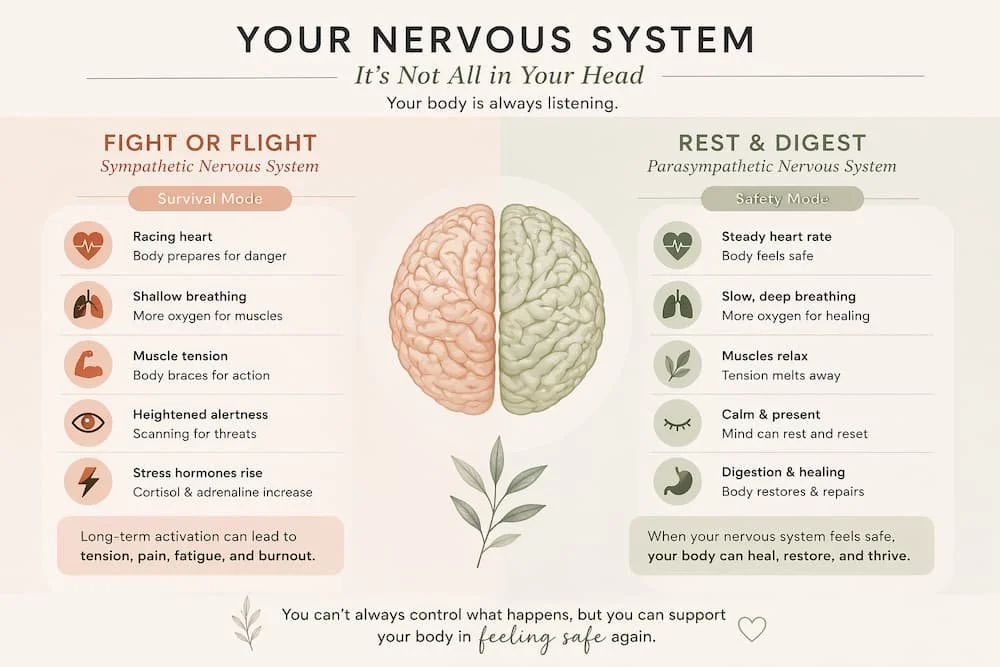
Your body shifts between states of stress and safety; relaxation only happens when your system feels safe enough to allow it.
Signs Your Body Isn’t Letting Go
Signs Your Muscle Tension Is Caused by Stress:
Your body may be holding stress in ways you don’t immediately recognize.
Tight shoulders that don’t relax
Jaw clenching or TMJ tension
Shallow breathing or holding your breath
Feeling tired but wired
Difficulty relaxing during a massage
Needing deeper pressure just to feel relief
These aren’t just muscle issues.
They’re signs your nervous system hasn’t fully shifted into a relaxed state.
Jaw tension is one of the most common signs of stress in the body, something I explore further in TMJ Massage Therapy in Calgary: How Jaw Tension Affects Your Whole Body.

Chronic tension often shows up in the neck and shoulders, especially when your body is stuck in a stress response.
Why Your Body Holds Tension Even When You Don’t Feel Stressed
This is where it starts to make more sense.
Your body doesn’t always respond to what’s happening right now.
It responds to what it has learned to expect.
How Your Nervous System Adapts to Chronic Stress
Common Ways Your Nervous System Adapts to Chronic Stress
Over time, your nervous system adapts to:
chronic stress
high responsibility
emotional pressure
constant stimulation
pushing through fatigue
And eventually…
👉 tension becomes your baseline
So when you try to relax, your body doesn’t trust it yet.
It stays guarded.
Not because something is wrong, but because it’s learned that being “on” is what’s safest.
Why Trying Harder to Relax Doesn’t Work When Your Body Is Stuck in Stress
This is where a lot of people get stuck.
Common Ways People Try to Relieve Muscle Tension (That Don’t Work):
stretching more
pushing deeper into pressure
trying to “force” release
But if your nervous system is still in a protective state, your body won’t fully let go.
In fact, sometimes:
more pressure = more muscle guarding
These approaches often focus on the muscles, but don’t address the nervous system patterns behind chronic tension.
(I go deeper into this in Why Deep Tissue Massage Doesn’t Always Work (and What to Do Instead).)
What Your Body Actually Needs To Relax
Your body doesn’t need to be forced into relaxation.
It needs to feel safe enough to allow it.
What Helps Your Body Relax Naturally:
slower, more intentional massage therapy
consistent massage therapy (not just one session)
working with your nervous system instead of forcing muscle release
gradual release instead of aggressive pressure
This approach aligns with what research shows about activating the body’s relaxation response-something discussed by Harvard Health Publishing when explaining how the body shifts out of stress mode.
How Massage Therapy Helps Your Body Let Go
When your nervous system begins to shift, everything changes.
How Your Muscles Respond to Massage Therapy:
soften more easily
respond better to treatment
hold less residual tension
Signs Your Body Is Starting to Relax:
deeper breathing
a sense of heaviness (in a good way)
less need for intense pressure
longer-lasting relief
This is what we’re actually aiming for.
Not just “looser muscles” -
but a body that can stay relaxed after the session ends.
This is where massage therapy for stress relief starts to create lasting change in the body.
The Missing Piece: Your Nervous System in Chronic Stress
Signs Your Nervous System Is Stuck in Stress Mode:
massage helps, but the tension comes back quickly
your body is always tight no matter what you do
you can’t fully drop into relaxation
…it’s often not a strength or flexibility issue.
It’s a nervous system pattern.
This is often why massage helps temporarily, but the tension keeps coming back.
This pattern is often tied to what’s known as a chronic fight-or-flight response, which I break down further in The Fight-or-Flight Epidemic: Why So Many People Are Stuck. For some people, this pattern also shows up as difficulty settling or focusing, which I explore more in Massage Therapy & ADHD: How Bodywork Supports Focus, Relaxation, and Nervous System Balance.
For a deeper understanding of how the nervous system regulates stress and recovery, National Institute of Mental Health also provides a helpful overview of how the body processes stress.

When your nervous system begins to settle, your body can finally shift out of survival mode.
When to Get Massage Therapy for Ongoing Tension
If your body feels like it’s constantly holding tension, that’s not something you need to push through.
It’s something to work with.
If this is where you’re at, this is exactly the kind of pattern I work with during therapeutic massage therapy in Calgary NW, where the focus isn’t just on releasing tight muscles, but helping your body actually shift into a state where it can let go.
When Your Body Finally Feels Safe Enough to Relax, Everything Changes
If you’re ready to feel the difference, you can book a session below.
If you’re not sure what a session looks like, you can also read What to Expect During a Therapeutic Massage in Calgary NW.
You Might Also Find Helpful:
Signs Your Nervous System Is Stuck in Fight-or-Flight
Massage Therapy for Nervous System Regulation: What Actually Works
TMJ, Stress & the Nervous System: Why Your Jaw Holds So Much Tension
Frequently Asked Questions
-
Your body may be stuck in a low-level stress response (fight-or-flight). Even if your mind wants to relax, your nervous system may still feel unsafe, keeping your muscles tense and your body alert.
-
It’s common, but not something you have to live with. Chronic tension is often a sign your body has adapted to ongoing stress and hasn’t fully returned to a relaxed baseline.
-
If your nervous system is still in a protective state, your muscles may temporarily release but quickly tighten again. This is why addressing the nervous system—not just the muscles—is key.
-
Yes. When approached properly, massage therapy can help shift your nervous system into a more relaxed state, allowing your body to release tension more naturally and for longer periods.
-
There isn’t a single “quick fix,” but consistent inputs like slow breathing, reducing overstimulation, and regular bodywork (like massage therapy) can help your system gradually shift into a calmer state.
💜 I welcome all bodies, all backgrounds, and all identities. This is a space where you are supported and valued—without judgment.
